
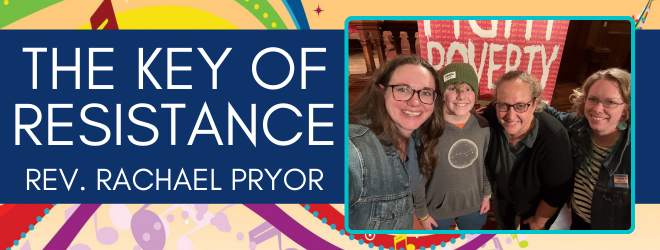
If you’ve ever been in the sanctuary of First Congregational United Church of Christ in Long Beach, you know how cavernous it is. On Monday night, with about 50 people gathered for a song circle, I admit that I had doubts. How could we possibly fill up this space with so few voices? I worried that we would leave feeling inadequate to the heartbreaking demands of this time.
I should have known better than to doubt the inestimable Pauline Pisano of the Kairos Center for Religions, Rights, and Social Justice. By the end of the night, our cries of Freedom! Freedom! echoed into the far corners of the balcony; and somehow, as we drove home in the darkness, the future felt a little bit brighter.
The event, “We Sing Freedom,” was co-sponsored by some of our longtime partners like CLUE Justice and LA Voice, part of a nationwide weekend of community sing events (like this Singing Resistance Music Vigil for Justice hosted on Sunday afternoon by Claremont UCC). The Kairos Center’s Songs in the Key of Resistance: A Movement Songbook is one of the leading resources for this collective action.
For almost two hours, we moved from slow, somber refrains like “Justice / Let it be so” to the strident chants of “No one is getting left behind this time/We get there together or never get there at all.” Kairos staffers Ciara Taylor and Charon Hribar shared more songs, poems, and stories, along with local leaders like Arnaé Barton. The range of themes and issues connected by music showed us the power of “cross-pollination across different fronts of struggle,” in Ciara’s words. As she invited us to sing in languages other than English – the primary or only language of most participants – she reminded us how singing new songs, and in new languages, is a gentle way to practice getting used to discomfort. “If you’re comfortable all the time, you’re not building community.”
Pauline is based near Joshua Tree, but I first met her last summer in Kansas City at a Kairos event before General Synod that took place in a church that used to be a stop on the Underground Railroad. Last night’s event was a perfect example of how Kairos works: creating connections, strengthening relationships, calling us together not only across states and countries, but from the legacy of our ancestors and into future generations. We learned new skills for supporting protests and gatherings; we shared updates about local organizing events and opportunities.
Throughout the evening, I watched through the eyes of my almost-thirteen-year-old daughter, Greta. She was greeted with a hug from her favorite Pilgrim Pines counselor, Rev. Wally Hoeger, while Rev. Petra Malleis-Sternberg (Associate and Senior Ministers at First Church respectively) welcomed visitors from neighboring faith communities. Nervous and shy at first, Greta grew progressively louder and more engaged throughout the evening. “Make sure you take a video!” she demanded, as we built the five-part harmony of the final song. She chattered for the entire 90-minute drive home about all the ideas and impressions she had gathered.
I hardly know what to say to adults about the state of the world, let alone to a child. Another war in the Middle East – really?! A renewed crackdown on Gaza while we’re distracted by Iran? Drawings destroyed and crayons confiscated from children in our nation’s largest concentration camp in Dilley, Texas? How do we summon the “courageous and concrete action” our denominational leaders and global partners are calling for? The only way I know to respond, is one note at a time. One more gathering. One more evening of claiming hope in the midst of despair. One more generation, willing to stand with strangers and overcome discomfort to learn the songs that will build a community big enough to drown out hatred with the music of peace and justice. May it be so.